A Moving-Day Pack for the First Useful Evening
A moving-day pack keeps familiar evening essentials together, so you can eat, wash and settle in before the rest of the boxes are unpacked.
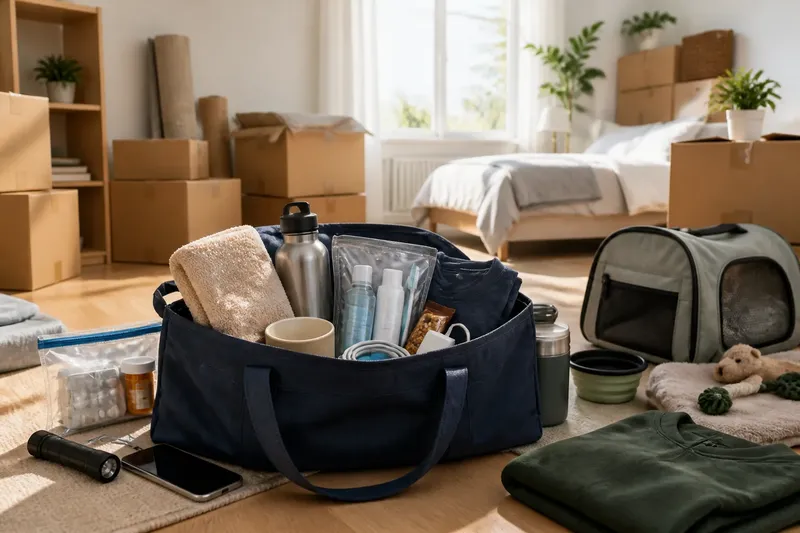
The last box has reached the new room, the kettle is somewhere behind a tower of cartons, and the person holding the tape dispenser would like to stop making decisions. A moving-day pack for the first useful evening keeps a small group of familiar essentials together, so the room can become usable without unpacking everything.
This is not a miniature version of the whole household. It is a deliberate choice about what the first evening is likely to ask of you: a way to drink, wash, change, find a light and manage the next morning. The right contents depend on who is arriving, what the room already provides and how much can be carried without turning the pack into another box to lose.
What does a first-evening pack need to do?
Start with the evening’s functions, not a shopping list. In an unfamiliar room, small interruptions can become awkward because the usual objects are separated, labelled vaguely or still in transit. A pack earns its space by making a few ordinary tasks possible while the larger move remains unfinished.
Think in linked uses. A drink needs a cup and something to drink; washing needs a towel and the relevant toiletries; getting ready for bed needs sleepwear and a clean place to put worn clothes. A phone may need its charger, but the charger is useful only if the plug and socket arrangement is known. These links help distinguish essentials from things that merely feel reassuring while packing.
Make the pack small enough to identify at a glance, but not so small that its contents depend on a second box. A sturdy tote, a small suitcase or a lidded plastic crate can work. Choose something that is easy to carry, can be set down without spilling and is visually distinct from ordinary cartons. If the room is reached by stairs or shared access, handling matters as much as capacity.
Keep the items together by immediate use. A loose assortment of useful objects is still a rummage; grouping them reduces the number of decisions made when you are tired.
Which situation describes your arrival?
The pack should reflect the conditions at the destination, not an ideal evening in a fully unpacked home. Choose the situation that most closely matches your move, then adjust for the people and facilities involved.
If the room will be empty and the utilities are ready, what fits?
For an empty room with working lighting and water, focus on personal essentials and a simple drink or snack. Include a towel, soap, toothbrushes, toilet paper if the bathroom is not yet stocked, drinking cups, a phone charger, sleepwear and bedding or the parts needed to make the bed. A small bin bag is useful for wrappers and packing scraps, but it need not become a collection of cleaning supplies.
This is the leanest arrangement because the room already supplies the basic services. There is little reason to carry extra equipment that can be unpacked during daylight. If the bed is assembled and the bathroom is accessible, the pack can stay compact.
If the room is furnished or shared, what should change?
In a furnished room, leave out items that are already there and safe to use. A lamp, bedside surface, cups or towels may be provided, but do not assume that every shared cupboard contains what you need or that a communal item is available at the moment you want it. Bring personal toiletries, medication you normally keep accessible, a clean change of clothes and a phone charger.
For a shared home, add a small amount of consideration for other people: use a cup or bottle that is clearly yours, keep toiletries contained, and avoid taking over a common counter with unpacking. If you need to ask where something belongs, ask before spreading belongings across a shared space. The first evening is an unpromising time to discover that a shelf has an established owner.
If the move is delayed or the room is not ready, what fits?
If access may be late, the room has not been cleaned, or the sleeping arrangement is uncertain, pack the items that stay useful while carried: water, a simple snack, phone power, essential medication and a spare layer. Keep these within reach rather than buried in the main load. Bedding and toiletries can remain in a separate group until you know where they will be used.
That separation prevents the whole evening pack from depending on a room that may not yet be available. If you are travelling with children, an older person or someone who needs a particular comfort or care item, keep that person’s essentials accessible as a separate personal group, not at the bottom of a shared crate.
If you are moving with pets, what fits?
For a pet, make a distinct small group for familiar food, a bowl, lead or carrier, waste bags and any usual comfort item. Keep it separate from human toiletries and food, and make sure the animal can be settled without opening several cartons. A familiar mat or blanket can make a new room less strange without requiring the rest of the household to be unpacked.
Consider the pet’s needs and the room’s boundaries before arrival. If the destination has rules about animals or access, check those in advance rather than relying on a reassuring guess made beside the van.
How should you group the contents?
Use a few clear groups rather than one undifferentiated heap. The point is not to create a perfect packing system; it is to make the first use obvious. Transparent pouches, small reusable bags or separate compartments can keep related objects together without adding much bulk.
- Drink and a simple bite: a reusable bottle or cup, a snack that travels well, and any utensil needed to eat it. Choose food that does not require cooking, refrigeration or a search for a particular kitchen tool.
- Wash and change: a towel, toothbrushes, toothpaste, soap, basic toiletries and clean sleepwear. Keep liquids upright in a sealed pouch to prevent a leaking bottle from turning the rest into a damp parcel.
- Sleep and morning: bedding essentials, a clean change of clothes and anything needed to get dressed or leave the room the next day. If bedding is bulky, treat it as a clearly marked separate bundle rather than pretending it fits neatly in a small tote.
- Light and connection: a phone, its charger and a compact torch if the room’s lighting or access is uncertain. Do not pack a plug adaptor or extension equipment unless you know it is suitable for the room and the item being used.
- Personal needs: regular medication, glasses, hearing aids or other items you would not want to search for at night. Keep them in their usual safe container and within your own control.
Labels should name the use, not the vague category. “First evening: wash and sleep” is more helpful than “miscellaneous”, which is what labels become when their author has run out of patience. Mark the pack on more than one side if it may be stacked among other belongings.
What should stay out of the pack?
Leave out anything that is bulky, fragile, difficult to replace or unlikely to be used before the next day’s unpacking. A full set of cookware, several books, decorative objects and a complete cleaning kit may all be useful later. Their usefulness does not make them first-evening essentials.
Also resist packing duplicate supplies just because they are available. A second towel, spare mug and extra toiletries can quietly turn a small tote into a box with a handle. If an item has a specific role, keep it; if it is only present because there is room, ask whether the room’s first evening actually needs it.
For medicines, food, electrical items and other products with handling or use requirements, follow the label, manufacturer’s instructions or relevant local rules. Keep anything sensitive in its appropriate storage rather than assuming a moving bag is suitable.
How can you decide what belongs in yours?
Use a short decision sequence while packing. It should sort the contents, not become another elaborate project.
- Name the first evening’s likely tasks. Write down the few things you expect to do before sleeping and leaving the room the next morning. Include only tasks that are likely, not every possible inconvenience.
- Check what the destination already supplies. Confirm access to a bed, bathroom, lighting, water and any shared facilities that matter. Remove items that are reliably available, while keeping personal necessities.
- Pair each task with its enabling items. For washing, group the towel and toiletries. For a drink, include a cup or bottle and something to drink. If a task requires an object that will be in another carton, either move that object into the pack or simplify the task.
- Separate immediate needs from uncertain ones. Put essential personal items in the pack; keep optional bedding or room-dependent items in a labelled companion bundle. This avoids making every item depend on the same assumption about the room.
- Carry the pack once before closing it. Check that it is manageable and that the contents remain together. If it feels unwieldy, remove items with a later use rather than splitting one essential group across multiple cartons.
Say you are moving into a furnished room with a working bathroom, but you do not know whether the kitchen will be accessible that evening. You keep a towel, toiletries, sleepwear, phone charger, water bottle and a snack in a small tote, while leaving the kettle and plates in the kitchen carton. The expected result is straightforward: you can wash, drink and settle without relying on kitchen access, then unpack the cooking items when the room’s arrangements are clear.
What if the plan changes?
A first-evening pack should tolerate a change in timing without becoming a second household to manage. Keep the most personal and time-sensitive items together, and make the remaining contents easy to adapt. If the move finishes early, the pack can still serve as a useful starting point; if it runs late, it should provide access to the essentials that matter while the room is still in flux.
Do a final check at the departure point, where the objects are visible and the context is familiar. Ask whether the room’s likely first tasks can be handled with what is inside, whether anything essential has been left in a personal bag, and whether someone else needs a separate group of their own. The useful version of a moving-day pack is the one that can be found, carried and used without negotiation.
Keep the moving-day pack modest and tied to the first evening’s actual conditions. A clear group of familiar essentials is more valuable than a carefully packed assortment whose first task is to be unpacked.