One Room, Two Jobs: Fixed Zones or a Clear-Down Surface?
One room, two jobs: compare fixed zones with a clear-down surface and choose an arrangement that fits how often each activity happens.

At half past five, a dining table can be covered in sketch paper while someone is trying to make supper beside it. One room, two jobs is a familiar space problem: should each activity keep a fixed zone, or should both share a surface that is cleared between uses? The answer depends less on the room’s ideal layout than on how often each job happens, what it leaves behind and how costly it is to switch.
Consider an invented situation: Mara lives in a small flat and uses her only large table for evening meals and occasional sewing. Her sewing machine and fabric are currently stored in a cupboard; when she sews, she spreads out the work, then packs everything away. She is deciding whether to reserve one end of the table for sewing or keep the entire surface available to whichever activity is happening. This walk-through follows that choice from the room’s ordinary demands to a workable arrangement.
What does each activity ask of the room?
Before moving furniture, Mara writes down what the two activities actually need. Dinner needs a clean, reasonably broad surface, chairs that can be reached, and a route between the kitchen and the table. Sewing needs the machine, fabric, scissors, thread and enough room to lay out a piece without folding it over itself.
She distinguishes between things that must stay in place and things that merely need to be nearby. The sewing machine is awkward to carry and needs a stable surface. Thread and scissors are small and can live in a box. The table itself is useful to both activities, while the chairs and clear floor are not optional extras: a zone that blocks the route to a seat is a zone that has annexed the room.
This inventory prevents a common mistake: assigning territory before understanding the work. A dedicated zone is helpful only if it accommodates the activity, not simply because a corner appears available. Likewise, a shared surface works only if the objects can be removed without turning each changeover into a small archaeological dig.
Write down the objects each activity needs and the space each one occupies while in use.
How often does each job take place?
Mara looks at the pattern rather than relying on a vague sense that sewing happens “quite often”. Dinner is an everyday use of the table. Sewing comes in bursts: some weeks she uses the machine on several evenings; other weeks it remains in the cupboard. The meal space has a frequent, predictable claim. Sewing’s claim varies, though it can last for a long session once it begins.
Frequency is not the only measure. A short activity that happens daily may deserve a permanent place because repeated setup is irritating. A less frequent activity might also merit a zone if it is difficult to dismantle and resume. Conversely, an activity that uses a few portable items may share a surface easily, even if it recurs regularly.
Mara considers how often she would need to clear the sewing setup for dinner, and how much work that would involve. If she must remove the machine, sort loose thread and fold an unfinished project every evening, the shared-surface arrangement may quietly discourage sewing. If sewing happens only occasionally and can be boxed away together, a fixed zone could consume valuable table space for long stretches when it is not needed.
Count the transitions, not just the sessions. A room used for two jobs may require a changeover every time the jobs alternate, and those changes are part of the arrangement’s real cost.
Would a fixed zone earn its footprint?
A fixed zone reserves a particular area for one activity. It might be a desk for paperwork, a low shelf for a child’s building materials or one end of a dining table for a regular craft. Its main advantage is readiness: tools can stay arranged, work can remain in progress, and the activity can resume without being reconstructed.
Its drawback is that reserved space remains reserved when the activity is absent. In a compact room, a permanent work corner can narrow a walkway, reduce seating or make the shared surface too small for its other job. A zone can also spread beyond its borders. A basket that grows into a pile is not a boundary; it is a proposal awaiting rejection.
Mara tests the idea on paper. A permanent sewing end would leave less room for serving dishes and diners. The machine would be ready, but dinner would require shifting it or negotiating around it. She decides that the convenience of immediate sewing does not outweigh the daily intrusion on the table’s more frequent use.
That decision would change if sewing became a regular, hard-to-pause activity, or if another surface could take over meals. A fixed zone is not inherently untidy or inflexible. It is a sensible choice when the activity’s need for continuity outweighs the space it occupies when idle.
Can the shared surface be cleared without losing the work?
A clear-down surface returns to a neutral state between activities. That does not mean every object must vanish into a distant cupboard. The useful question is whether the work can be gathered into a defined container or onto a tray, leaving the surface ready for its next job.
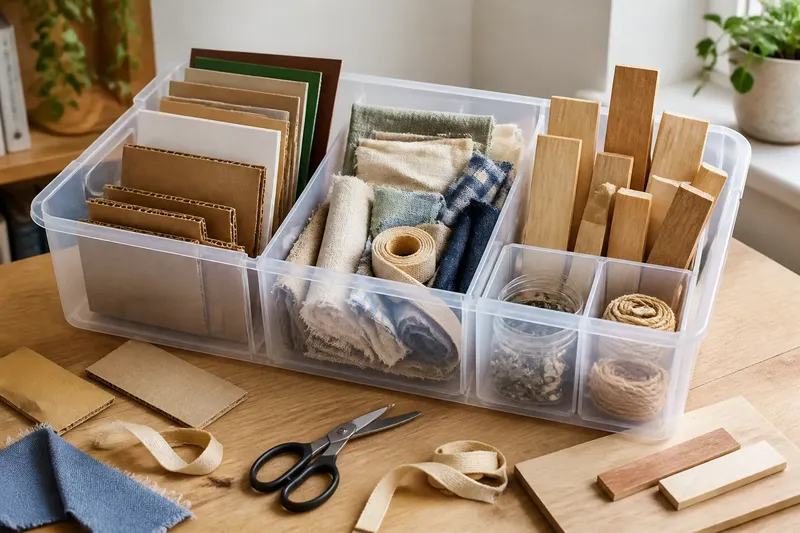
Mara chooses a shallow lidded box for thread, scissors, needles and measuring tape, plus a flat project folder for fabric pieces and pattern notes. The machine is the awkward item. She checks whether a nearby shelf can hold it securely and whether moving it is manageable for her. The arrangement is only practical if the machine’s resting place is accessible and the table is not left carrying its weight by default.
She also protects unfinished work from being mixed with general household items. The project folder keeps small pieces together, while a note tucked inside records what she intended to do next. That note is not a grand productivity system; it saves her from rediscovering the state of a half-finished seam after a gap.
Say Mara finishes a sewing session with fabric cut for a cushion cover. She places the cut pieces and pattern in the folder, returns the small tools to the box, and moves the machine to its shelf. The expected observable result is a clear table for dinner and a contained project that can be brought back out without sorting through unrelated belongings.
A shared surface works best when “cleared” has a specific meaning: what leaves, where it goes, and what must remain together.
What arrangement fits this room?
Mara compares the options against her actual pattern. The table is needed for meals far more consistently than for sewing, the sewing tools can be grouped, and the machine has a possible nearby home. She chooses a shared surface with a compact storage place for the project, rather than a permanent sewing zone.
She does not attempt to make the whole room serve both activities equally. The dining chairs stay where they are easiest to use, and the route from kitchen to table remains clear. Sewing gets a nearby shelf and a box, but not a permanent claim on the table. This distinction matters: activities can share a main surface while keeping separate storage and supporting arrangements.
A different room could point the other way. Imagine an invented household where a resident uses a laptop for focused work every day and the dining table is rarely needed for meals. If the work setup includes a monitor, paperwork and a chair adjusted for long sessions, leaving it assembled may suit the room better than packing it away repeatedly. The observable sign is not a promised improvement in output; it is simply that the work surface remains ready and the less frequent activity still has somewhere suitable to happen.
Choose the arrangement by comparing frequency, continuity, clearance effort and the room each activity needs at its busiest. No single factor settles every case. A rarely used activity can deserve a fixed zone if it cannot be paused; a frequent one can share if its equipment packs together neatly.
Which questions settle the choice?
How often should an activity happen before it gets a fixed zone?
There is no universal frequency threshold. A fixed zone makes sense when repeated setup is burdensome or the activity needs to remain ready, provided the reserved area does not undermine the room’s other regular uses.
What if both activities happen every day?
Compare how much space each needs at the same time and how difficult a changeover would be. If both need the full surface, look for a second modest work area or a different room arrangement rather than pretending one table can host two simultaneous jobs.
How can a shared surface work with unfinished projects?
Give the work a container, tray or folder that keeps related pieces together and has a known place to live. Keep anything fragile or awkward to move only where it will not obstruct the next use or the room’s route through the space.
When should the arrangement be reconsidered?
Revisit it when the pattern of use changes, when stored items begin to spill into the working area, or when clearing the surface is repeatedly postponed. Those are observable signs that the layout no longer fits the room’s current jobs.
How will Mara know whether the choice still works?
For now, Mara’s clear-down arrangement fits: dinner keeps the table, sewing remains possible, and its tools have a contained home. She watches for practical evidence rather than trying to defend the original decision. If the machine is repeatedly left out because moving it is too much trouble, a small dedicated sewing zone may be justified. If the project box sits untouched and the shelf is more useful for something else, she can reclaim that storage.
It helps to judge the room by the moments when both uses are competing, not by how orderly it looks when nobody is doing anything. Can a chair be pulled out? Can the table be restored without shifting a heap from one surface to another? Can the ongoing activity resume without hunting for its parts? These questions make a layout’s success visible.
For one room, two jobs, fixed zones suit activities that need continuity and can afford the footprint. A clear-down surface suits activities whose tools can be gathered and whose claim on the main work area is intermittent. Mara’s sewing and dinner arrangement is not a rule for every small home; it is a decision based on which job recurs, what must stay ready and what can be put away intact.
Keep the choice provisional. In a changing room, the useful arrangement is the one that still lets the next activity begin without making the previous one a permanent tenant.