The Routine That Breaks When One Step Is Missed
A routine that breaks after one missed step can restart with a small cue, helping you choose the next useful action without recreating the whole sequence.
The kettle clicks off, the toast is ready, and then a message pulls you into another room. By the time you return, the kitchen routine has vanished along with the mug you meant to wash. A routine that breaks after one missed step often needs a restart cue, not a more elaborate schedule.
The useful question is not how to complete every part exactly as planned. It is how to recognise the interruption, find the next relevant action and resume without turning a small gap into a failed morning. That calls for a routine with a clear point of re-entry.
Why does one missed step stop the whole routine?
Some routines work like a chain: one action reminds you of the next. Put lunch in a bag, fill a water bottle, check the door for keys. If the chain is interrupted, the cue that would have carried you onwards may be gone. You return to the task, but cannot remember whether you packed lunch or only thought about packing it.
Another cause is an invisible finish line. If “get ready” means several actions with no obvious endpoint, missing one can make the whole routine feel unfinished. People then restart from the beginning, often discovering that they have already done half of it. This is less a failure of discipline than a poor way to mark progress.
Make the end of a routine visible: close the lunch bag, put the keys beside it, or turn a small card from “to do” to “done”. Choose a marker that belongs to the task, rather than adding an app or another reminder to manage.
What should you do when you return mid-task?
First, pause long enough to identify what remains. Do not assume that an interruption erased everything, and do not repeat each action just to feel certain. Look for ordinary evidence: the dry plate on the rack, the closed laptop, the note already moved to the outgoing pile.
Then choose the next useful action, not necessarily the next action in the original order. If the morning sequence has been broken and you are already dressed, there is little value in mentally replaying the whole sequence. Pack the item still missing, or leave a note if it cannot be done now.
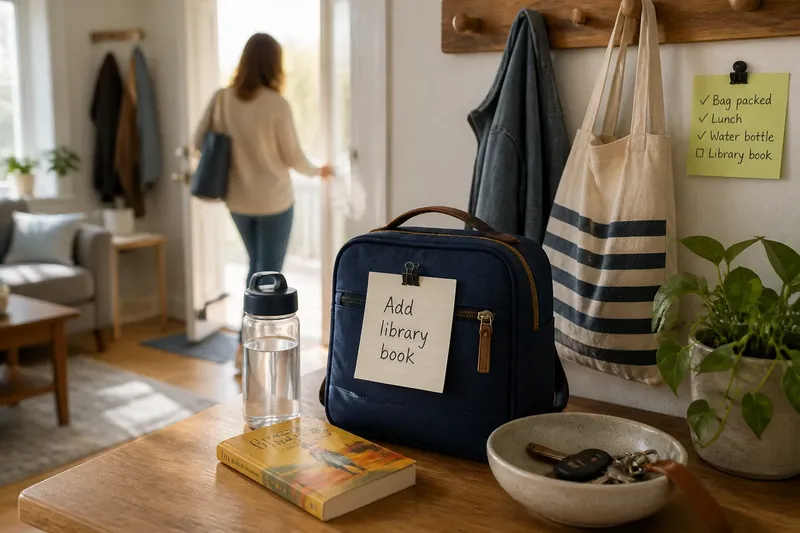
Say you are interrupted while preparing a child’s school bag to answer the door. You return to find the lunch bag zipped but the reading book still on the table. The next useful action is to put the book in the bag, not to unpack lunch and repeat the entire packing sequence.
If you cannot tell what has been done, make one quick check of the relevant place or object. Settle on a simple signal for “checked”, such as placing the completed item by the front door. Rechecking can be sensible; repeatedly checking without a new reason usually adds work rather than clarity.
How can a short restart cue help?
A restart cue is a small, repeatable action that tells you where to begin again. It should be easy to spot and specific enough to answer, “What now?” A note saying “resume” is less useful than “put the forms in the blue folder”. The cue can be a written phrase, an object left in a particular place, or a deliberate action that marks your return.
For a routine that involves several rooms, use one cue at the point where you are most likely to lose track. A basket by the stairs might hold items still to be carried up; a clipped note beside a packed bag might name the one remaining item. Keep the cue attached to the routine, so it does not become a separate system demanding attention.
A cue should point to a next action, not reprimand you for stopping. “Finish the whole kitchen” can feel too broad after a long interruption. “Put the clean mugs away” gives you a bounded place to start.
What if the routine no longer fits the day?
Sometimes the problem is not memory. The original routine may rely on time, materials or circumstances that are no longer available. If the bus is due, a full breakfast clean-up may not be practical. If the printer is out of paper, continuing the paperwork sequence is not an option.
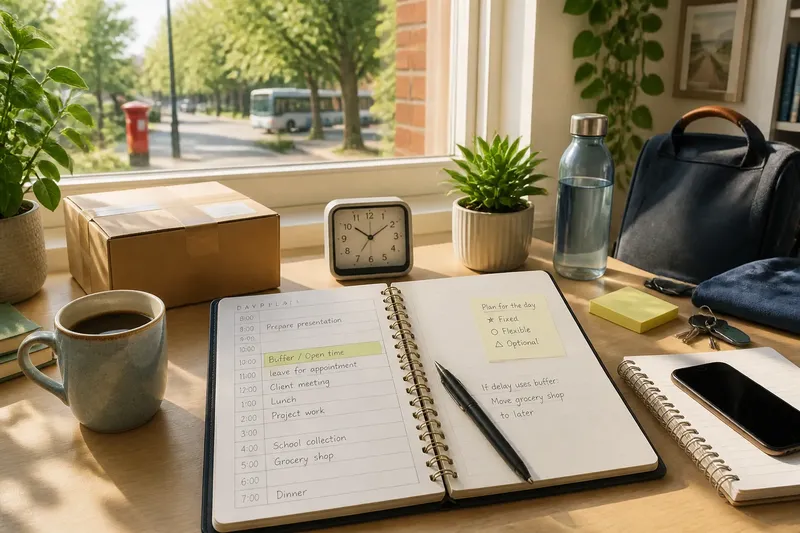
Decide what must happen now, what can be reduced and what can move to later. Keep the essential action visible, and leave the rest plainly marked rather than pretending it has been completed. A folded tea towel on the counter can remind you that the dishes remain; a note on the document can say which attachment is missing.
When the same step repeatedly becomes impossible, adjust the routine itself. Move the needed object to where the action happens, remove a step that serves no clear purpose, or choose a different time. A routine should respond to the conditions around it, not require you to reconstruct an ideal day before it can continue.
Which restart questions are worth asking?
Should I start the routine again from the beginning?
Only if the earlier actions must be repeated for a practical reason, such as a task that was interrupted before it was safely completed. Otherwise, check what is already done and continue from the first missing useful action.
What makes a good restart cue?
It is visible, concrete and tied to one next action. A note on the bag saying “add library book” is clearer than a general reminder to finish getting ready.
What if I keep forgetting the same step?
Change the cue or the setting rather than relying on greater concentration. Put the item beside something you already handle, or add a small marker at the point where the step belongs.
When should I drop a step?
If it does not support the purpose of the routine, or regularly obstructs an essential action, consider removing or relocating it. Keep steps that matter for safety, care or an explicit requirement.
How do you make restarting feel ordinary?
Use the same calm sequence whenever a routine breaks: notice what has happened, check what is complete, choose the next useful action and leave a cue for anything postponed. It need not be ceremonial. A glance at the counter and a pencil mark beside a task can be enough.
Try the routine during an ordinary interruption rather than waiting for a perfectly quiet day. If the cue is hard to find or the next action still feels vague, make it more visible or more specific. A routine that can restart is not one that never breaks; it is one that does not demand a full replay every time life edits the sequence.
For a routine that breaks after one missed step, keep the restart cue close to the place where you resume. That small placement decision can save you from having to remember the whole sequence just to do the next sensible thing.